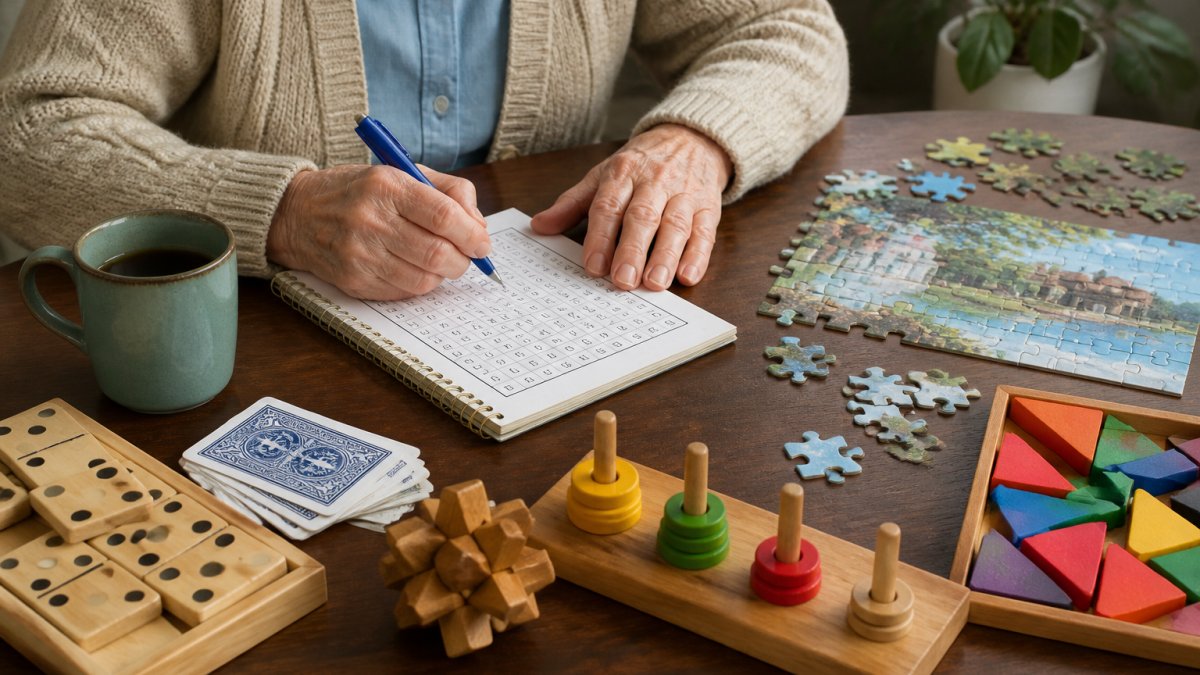
 blog
Best Brain Games for Early Stage Dementia
Table of Contents
- Why the Best Brain Games for Early Stage Dementia Are the Ones That Fit
- What the Evidence Says About Brain Games for Dementia
- Classic Puzzles and Activities for Early-Stage Dementia
- Simple Memory Exercises for Dementia You Can Do at the Kitchen Table
- Online Activities for People with Dementia: What Works and What to Avoid
- How Caregivers Can Adapt Games to Changing Abilities
- Building a Weekly Routine and Knowing When to Adjust
- Conclusion
- Frequently Asked Questions
Last Updated: October 17, 2026
Why the Best Brain Games for Early Stage Dementia Are the Ones That Fit
The best brain games for early stage dementia are not the hardest puzzles or the flashiest apps. They are the ones a person can still do with confidence, on their own or beside someone they love.
That distinction shapes this entire guide. Below, we break down which brain games work at this stage, which ones to skip, and how caregivers can adapt play as abilities shift.
What the Evidence Says About Brain Games for Dementia
Honest answer first: brain games are not a treatment. No puzzle reverses cognitive decline, and any product claiming otherwise is overselling. What games can do is support cognitive stimulation, routine, and social connection, which many clinicians describe as meaningful quality-of-life support.
That distinction is where most guides fall apart. The National Institute on Aging's guidance on cognitive health is clear that staying mentally active is one part of overall brain health, alongside physical activity, sleep, and social contact.
What Research Can and Cannot Establish
It helps to separate three questions that get blurred together:
- Can a game improve performance on that game? Often yes. People get better at crosswords by doing crosswords. That is practice, not transfer.
- Does that improvement carry into daily life? This is where the evidence gets thin. Most practitioners find that gains stay close to the trained task and do not reliably generalize to memory, orientation, or daily function.
- Does play slow or prevent dementia? No study supports that claim, and any product implying it is making a promise the science cannot back.
A common pattern in the research is that structured cognitive activity shows modest, short-term effects on engagement and mood, while claims about long-term cognitive protection remain unproven. That is not a reason to skip games. It is a reason to choose them for the right outcome.
How to Read a Product Claim
When a game or app markets itself for dementia, run it through a short filter:
- Does it promise to "prevent," "reverse," or "treat"? Treat that as a red flag.
- Does it cite a specific study, or just the word "science"? Vague authority is not evidence.
- Does it describe who the activity is for, or does it claim to work for everyone? Fit matters more than universality.
- Does it explain what you should expect to see, and over what timeframe? Honest products set modest expectations.
What Realistic Outcomes Look Like
Games help people living with dementia stay engaged, practice language and recall in low-stakes ways, and feel less isolated. Those outcomes matter on their own, and they are measurable in daily life: a person who finishes a puzzle feels capable, a shared card game produces conversation, a familiar word search fills a quiet afternoon. None of that requires a cure claim to be worthwhile.
Classic Puzzles and Activities for Early-Stage Dementia
Classic puzzles earn their place because they are familiar. Someone who did crosswords for forty years brings a lifetime of habit to the table, and habit is a powerful entry point when memory is changing. No tutorial needed.
Word Puzzles and Word Searches
Crossword puzzles, word searches, and anagrams are among the strongest choices at this stage. They exercise language and recall, and they scale easily. A caregiver can hand over a large-print word search on a favorite theme, or work a crossword side by side and offer hints without taking over.
The adaptation that matters most: drop the difficulty. A puzzle that once took twenty minutes may now take an hour, and that is fine. Success beats speed. Large-print versions reduce eye strain and frustration.
Jigsaw Puzzles and Card Games
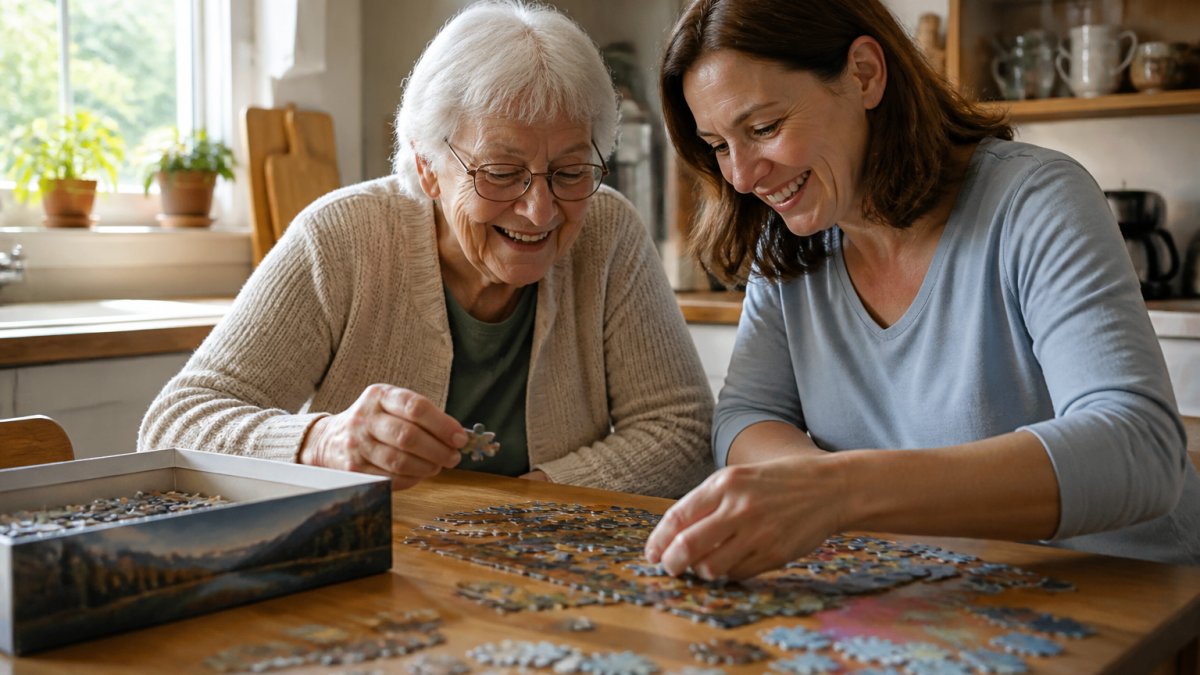
Jigsaw puzzles offer something word games do not: quiet, hands-on focus with a visible result. Choose puzzles with fewer pieces and clear image sections. Working the border first gives a natural starting structure.
Card games and simple board games add a social layer. Go Fish, rummy, and matching games rely on familiar rules and turn-taking. They keep attention on the group rather than on any one person's memory.
Simple Memory Exercises for Dementia You Can Do at the Kitchen Table
Simple memory exercises for dementia work best when they feel like conversation, not testing. The moment an activity feels like an exam, people disengage. Keep it light.
Try these at home:
- Name that photo. Lay out a few family photos and ask open questions about who, where, and when.
- Category lists. Take turns naming items in a category, such as fruits or animals.
- Recall the day. Walk through the morning together: what was for breakfast, who called, what the weather is doing.
- Song recall. Hum a familiar tune and fill in the next line together.
- Simple matching. Pair cards, lids, or household items by color or shape.
A common mistake is correcting wrong answers. Gently redirect instead. The goal is participation and recall practice, not accuracy.
Online Activities for People with Dementia: What Works and What to Avoid
Online activities for people with dementia can be genuinely useful, or a fast route to confusion. The difference is design. A good digital game uses large text, simple navigation, and no requirement to remember a password. But design is only half the story. Whether a game is comfortable to play depends on the person's vision, hearing, dexterity, and tolerance for screens, and those vary more than most guides admit.
Start With Accessibility, Not the Game
Before you evaluate any app, check the barriers that quietly end digital play:
- Vision. Look for large, high-contrast text and buttons, and support for system-level text scaling. Age-related vision changes are common, and small gray type on a white screen is a fast exit.
- Hearing. If the game uses audio prompts, confirm there are captions or a visual equivalent. Volume controls that are easy to find matter more than rich sound.
- Dexterity. Generous touch targets, drag-free interactions, and no requirement for precise tapping or fast swipes. Tremor and arthritis make small targets frustrating.
- Screen fatigue. Shorter sessions beat long ones. A 10- to 15-minute block is easier on attention and eyes than a 45-minute marathon.
- Device familiarity. A tablet that stays on the kitchen counter is easier than a phone that lives in a pocket. Fewer steps to start means more sessions actually happen.
What to Look for in the Game Itself
- Large buttons and high-contrast text
- Voice input instead of typing
- One clear task per screen
- No timed pressure or scorekeeping that punishes
- Familiar formats, such as digital crosswords or matching games
- A clear way to pause and come back later
What to Avoid
Apps with cluttered menus, pop-up ads, complex logins, or leaderboards add cognitive load and invite frustration. So do apps that require the person to remember a password, re-enter a code, or navigate a settings screen to begin. Login friction is the most common reason seniors abandon a digital activity after the first week.
Where a Purpose-Built Tool Fits
This is where AskMarty fits naturally. Its interface is built for aging eyes, with large text and generous touch targets, voice input, and no passwords for the senior user.
A purpose-built tool is not the only path. A large-print digital crossword on a familiar tablet can work well. The test is the same either way: can the person start, play, and stop without help, and do they want to come back tomorrow?
How Caregivers Can Adapt Games to Changing Abilities
Adaptation is a skill, and it is the difference between a game that lasts and one that gets shelved. The core principle: change the game, not the person.
Use this quick reference when a game starts feeling too hard:
| Problem You Notice | Adaptation | Why It Helps |
|---|---|---|
| Long pauses, frustration | Reduce pieces or word count | Lowers cognitive load |
| Losing track of rules | Switch to a simpler familiar game | Relies on habit, not learning |
| Vision strain | Move to large-print versions | Reduces eye fatigue |
| Losing interest | Shorten sessions to 10-15 minutes | Prevents fatigue |
| Withdrawal from group play | Try solo games or one-on-one | Removes social pressure |
A useful rule of thumb: if a game takes more than a few minutes to explain, it is probably too complex for this stage. Familiar games beat novel ones. Repetition is not a problem; it is a comfort.
Building a Weekly Routine and Knowing When to Adjust
A routine turns games from an occasional activity into real cognitive stimulation. The goal is regular, low-pressure play, not marathon sessions.
A simple weekly structure:
- Daily: a short brain quiz or a few minutes of a word game
- Several times a week: a jigsaw or card game, solo or with company
- Weekly: a longer shared session with family or a caregiver
Progression should be gentle. When a game becomes easy, add a small challenge, such as a few more pieces or a harder word list. When it becomes frustrating, step back without ceremony.
Watch for signs it is time to adjust: skipping sessions, irritation, or declining interest. The Alzheimer's Association's guidance on staying active emphasizes matching activities to current abilities, which is exactly the principle here.
Conclusion
The hardest part of this stage is not finding games. It is keeping engagement consistent as abilities change, often from a distance. That is the problem AskMarty was built to solve: personalized daily brain quizzes, gentle medication and appointment reminders, voice-first interaction with no passwords, and a family dashboard so you can see activity from anywhere. Start a free trial with AskMarty and give your family a routine you can both rely on.
Frequently Asked Questions
Which brain games are suitable for early-stage dementia?
Games that match the person's current abilities and past interests work best. Crosswords and word searches, 24- to 60-piece jigsaw puzzles, simple card games like Go Fish or Uno, and familiar board games such as checkers or bingo are common starting points. The key is that the person can complete the activity with light support and still enjoy it. If a game causes frustration or confusion, switch to something simpler rather than pushing through. Familiar formats usually beat new, complicated rules.
Can brain games slow the progression of dementia?
Research does not show that brain games stop or reverse dementia. What the evidence supports is narrower: mentally stimulating activities can help with attention, engagement, and quality of life, and some studies suggest cognitive stimulation may offer modest benefits for thinking skills. Think of games as a way to keep someone active, social, and enjoying their day, not as a treatment. Anyone promising that puzzles will slow decline is overstating what is known. Pair games with medical care and real conversation.
How long should a person with dementia play brain games?
Short sessions work better than long ones. Try 15 to 20 minutes at a time, once or twice a day, and stop while the person is still enjoying it. Fatigue, hunger, and time of day all affect how well someone engages, so late morning is often easier than late afternoon. Watch for signs of frustration, such as sighing, pushing pieces away, or repeating questions, and end the session kindly. A short daily habit beats an occasional marathon.
Are online brain games helpful for people with dementia?
Online games and apps can be helpful when the interface is simple and the person can use it without help. Large text, voice input, and no passwords make a real difference for someone who is not tech-savvy. Digital options also allow daily quizzes tailored to a person's interests. The risks are small screens, confusing menus, and pop-ups. Choose tools built for older adults, test them together first, and keep sessions short. Online play should add engagement, not replace time with family.