 blog
9 Brain Games for Seniors to Play at Home
Last Updated: October 28, 2026
Quick Summary
Brain games for seniors at home include word searches, crosswords, card games, dominoes, Sudoku, trivia, and jigsaw puzzles. Keep sessions short, around 15 minutes, and stop while the game still feels fun. A simple weekly plan that alternates solo and social play makes the habit easier to keep.
- Large-print puzzle books and a highlighter remove the biggest barriers to word searches.
- Start Sudoku easy so the player finishes a puzzle and feels capable.
- Keep memory game rounds to about five minutes rather than one long session.
- Set up a game station with a puzzle book, cards, Sudoku, and a 100-piece jigsaw.
- Fifteen focused minutes, five days a week, beats one long frustrating session.
Table of Contents
- Why Brain Games for Seniors at Home Are Worth the Shelf Space
- 9 Easy Brain Games for Seniors to Start This Week
- Memory Games for Seniors That Make Recall Feel Like Play
- Brain Games to Play With Elderly Parents, Near or Far
- Free Online Games for Seniors and Digital Options That Fit
- How to Adapt Games for Memory Difficulties and Different Abilities
- A Simple At-Home Game Plan for the Week
- Start a Daily Brain Game Routine With AskMarty
- Frequently Asked Questions
Why Brain Games for Seniors at Home Are Worth the Shelf Space
Brain games for seniors at home give older adults a daily reason to focus, recall, and solve problems.
The appeal is practical. A puzzle or card game needs no appointment and no drive across town.
What the evidence actually supports matters here. A review of brain gaming research in older adults with cognitive impairment describes games delivered at home, in clinics, and in labs, without claiming a guaranteed result. And a large study of nearly 20,000 people age 50 and older found a link between number puzzles and brain function, though UCLA Health's overview of brain games for older adults is careful to call it a correlation, not proof.
So treat games as enjoyable mental activity, not medicine. That framing keeps expectations honest and the habit sustainable.
9 Easy Brain Games for Seniors to Start This Week
Start with what the player already enjoys. Interest predicts sticking with it far better than difficulty does.
Here are nine easy brain games for seniors, grouped by type.
Word Searches and Crosswords
Word searches suit almost everyone. Large-print versions remove the biggest barrier, and a highlighter makes found words easier to track. Crosswords add recall and general knowledge, so keep a beginner puzzle book nearby for low-pressure days.
Card Games and Matching Games
A standard deck covers a lot of ground: rummy builds sequencing and planning, and a face-down matching game works short-term memory without feeling like a test. Deal fewer pairs for a gentler round.
Board Games Like Chess, Checkers, and Dominoes
Chess rewards planning and patience, checkers moves faster for quick rounds, and dominoes suits groups because it needs no reading and little setup. All three support conversation while the game runs.
Number Puzzles Like Sudoku
Sudoku builds concentration and logic, but start easy. Large-print grids and "beginner" books let a player finish a puzzle and feel capable, which matters more than challenge level.
Trivia and General-Knowledge Games
Trivia taps long-term memory, often a relative strength. Family trivia nights work because everyone contributes; keep questions broad and skip anything that could embarrass a player.
Jigsaw Puzzles and Visual-Spatial Activities
Jigsaw puzzles build visual-spatial skills and reward patience. A 100-piece puzzle with a clear image suits most players. Drawing from memory, or copying a simple picture, offers another quiet option.
Memory Games for Seniors That Make Recall Feel Like Play
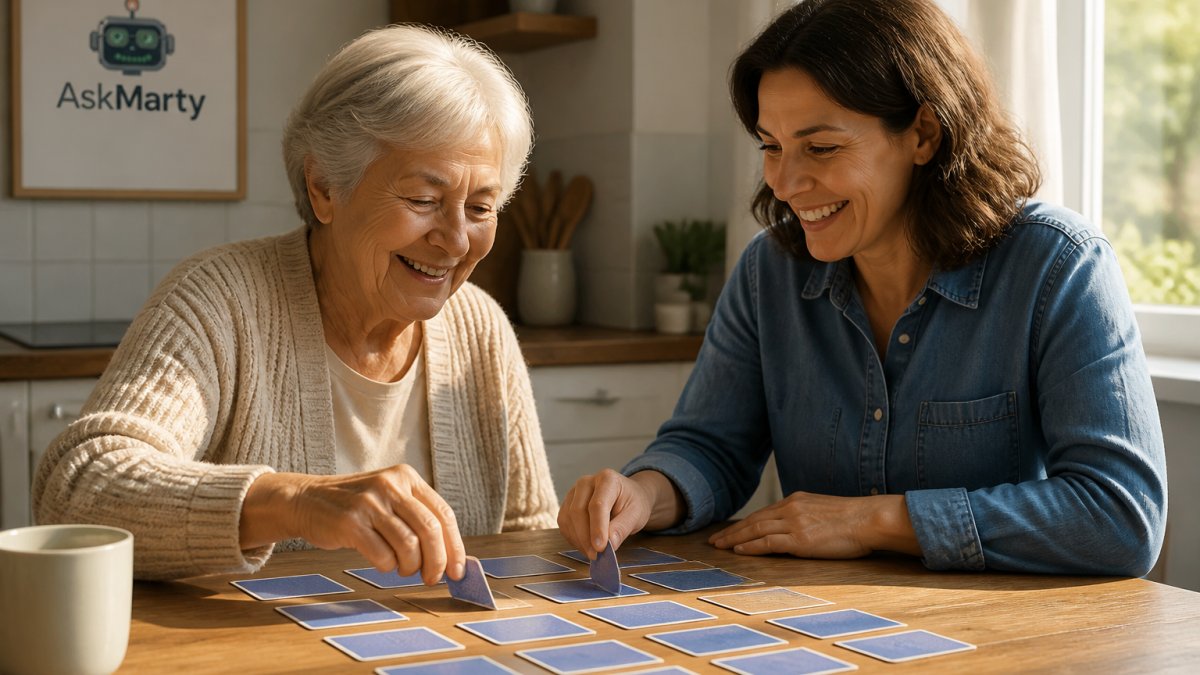
Memory games for seniors work best when they feel like a game, not a quiz. Three formats fit:
- Matching pairs: Lay cards face down and flip two at a time.
- Name that object: Cover household items on a tray, then recall them.
- Story recall: Read a short paragraph and ask for three details.
Keep rounds short. Five minutes of play beats a long session that ends in frustration.
A common mistake is correcting every miss. Let the player self-correct and keep the mood light. Recall practice helps most when it stays enjoyable.
Brain Games to Play With Elderly Parents, Near or Far
Distance does not rule out shared play. Brain games to play with elderly parents work over the phone, on video calls, or during visits.
Try these formats:
- Read a trivia question aloud and compare answers.
- Play word games like Scrabble or a simple word chain by voice.
- Set up two identical jigsaw puzzles and compare progress on a call.
For families nearby, a standing game night gives the week a rhythm; for families far away, a scheduled call around a game builds connection a plain check-in call rarely matches.
Free Online Games for Seniors and Digital Options That Fit
Free online games for seniors add variety when a puzzle book feels stale, and digital options work well for players who already use a tablet comfortably.
If a parent is new to technology, a slow start helps. The AskMarty guide on how to help seniors use technology covers the first steps in plain language. Families weighing AI tools alongside games can also read whether AI is safe for seniors before introducing anything new.
How to Adapt Games for Memory Difficulties and Different Abilities
Adaptation is the difference between a game that gets played and one that sits in a closet.
Start by watching one round without helping. Note where the player pauses, squints, fumbles, or loses interest, that tells you more than a general checklist, because the barrier is usually one concrete thing: the print is too small, the pieces are too slippery, or the round runs longer than attention allows.
Adaptations by barrier
| Barrier | What to change | Specific options |
|---|---|---|
| Low vision | Make the target bigger and higher-contrast | Large-print puzzle books, bold-tip markers instead of pencils, a bright desk lamp angled over the table, yellow or black paper behind white puzzle pieces |
| Hearing loss | Move information from sound to sight | Face the player when speaking, write trivia questions on index cards, use a small whiteboard for word-chain clues, keep background noise off |
| Limited dexterity or hand strength | Reduce gripping and fine placement | Card holders, magnetic puzzle boards, domino racks, foam dice, larger game pieces, a nonslip mat under the board |
| Fatigue or short attention | Shorten the round, not the challenge | Fewer pairs in a matching game, a 10-minute kitchen timer, a puzzle sorted into "today" and "later" bags |
| Mixed abilities in one group | Give each player a real role | One person sorts pieces, one reads clues, one keeps score, one places, everyone contributes without competing |
| Memory changes | Add cues instead of tests | Leave a written list of found words visible, keep a photo of the finished puzzle on the table, allow open-book trivia |
Set up the table before the player sits down
Most friction disappears with five minutes of prep: clear the table, put out only this round's pieces, and place the marker or card holder within easy reach on the player's dominant side. If the game has a rulebook, write the two or three rules that matter on a sticky note and set the book aside.
Keep difficulty in the "just right" zone
The useful target is a game the player can finish with effort but without help. A useful target is a game the player can finish with effort but without help. If they miss several turns in a row, drop a level without comment, swap a 100-piece puzzle for a 60-piece one, or a standard Sudoku for an easy grid.
Scripts that keep the mood light
How you respond matters as much as the game itself. A few phrases that work:
- "Take your time, I'm not going anywhere."
- "Want a hint, or do you want to sit with it?"
- "That was a good try. Let's see what's next."
Avoid correcting every miss, finishing the puzzle for the player, or saying "don't you remember?" Let the player self-correct where possible and treat a wrong answer as part of the game rather than a test result.
When to stop
End the session while it still feels good. Signs to wrap up include repeated sighs, pushing the pieces away, changing the subject, or a sharp drop in accuracy.
If a parent is new to a particular game, the AskMarty guide on how to help seniors use technology covers the first steps for digital versions in plain language.
A Simple At-Home Game Plan for the Week
A routine beats willpower. The plan below is ready to use as written, but it is a starting point, not a prescription, swap any day for a game the player already loves.
Before the week starts
Spend 15 minutes on setup so the habit does not stall on day one:
- Pick one shelf or basket as the game station, within reach of the usual chair.
- Put out a large-print puzzle book, a standard deck of cards, a beginner Sudoku book, and one 100-piece jigsaw.
- Add a bold marker, a card holder, and a small timer.
- Write the week's plan on an index card and tape it inside the basket lid.
The weekly plan
| Day | Activity | Time | Who | Setup |
|---|---|---|---|---|
| Monday | Word search | 15 min | Solo | Large-print book, highlighter |
| Tuesday | Matching card game | 10-15 min | With a family member | 12 pairs face down |
| Wednesday | Trivia call | 15 min | With a grandchild by phone | 10 questions written out |
| Thursday | Sudoku, beginner | 15 min | Solo | Easy grid, pencil |
| Friday | Jigsaw puzzle | 20 min | Solo or with a visitor | 100 pieces, clear image |
| Saturday | Dominoes or checkers | 20-30 min | With a visitor | Board and pieces out |
| Sunday | Free choice | 15 min | Anyone | Whatever felt best |
How to run each session
Keep sessions short and stop while it still feels fun. A few habits make the plan stick:
- Same time, same chair. Anchor the session to something that already happens, after breakfast, before the afternoon news, so it does not require a decision.
- Start with a warm-up. One easy puzzle or a single round of cards gets the player into the activity before the harder part.
- End on a win. Finish with something the player can complete, even if it is a single word or one card flip.
Vary difficulty week to week
If the player finishes most rounds easily, move up a level next week, a harder Sudoku grid, a 200-piece puzzle, or trivia with a narrower category. If a game produces sighs or repeated misses, drop back a level without comment and try again in a few weeks.
When a day gets missed
Missed days are normal. Do not double up to catch up, just pick up at the next scheduled day. If a whole week slips, restart with the two easiest days (Monday and Thursday) and rebuild from there. The plan works because it is forgiving, not because it is strict.
Mixing solo, partner, and group play
The plan deliberately alternates solo days with social ones: solo play builds a daily habit the player controls, while partner and group play add conversation and connection.
For families who want a daily anchor between game days, AskMarty Daily Brain Quizzes and AskMarty Daily Reminders for medications, hydration, and appointments can fill the gaps, and the AskMarty Family Dashboard lets invited family members see supported activity and send encouragement from anywhere.
Start a Daily Brain Game Routine With AskMarty
AskMarty offers daily brain quizzes with five questions, plus reminders for medications, hydration, and appointments. The Family Dashboard lets invited family members see supported activity and send encouragement from anywhere.
The Basic Plan includes access for one family member, and the Family Plan supports up to three.
For more ideas on keeping a parent engaged, browse the AskMarty blog for related guides.
Frequently Asked Questions
What are some fun brain games for seniors to play at home?
Word searches, crossword puzzles, card games like Rummikub, board games such as checkers and dominoes, Sudoku, trivia, and jigsaw puzzles all work well at a kitchen table. The best choice is one the person actually enjoys, since a game that feels like a chore gets abandoned. Start with something familiar, keep sessions short, and rotate between two or three favorites so it stays fresh. Family members can join in person or by phone for added connection.
How long should a senior spend on brain games each day?
Short, regular sessions beat long marathons. Fifteen to twenty minutes of a puzzle or card game most days is a realistic starting point, and it is fine to break that into two shorter rounds. Watch for signs of frustration, like sighing, giving up, or losing interest, and stop before that point. The goal is pleasant engagement, not a score. AskMarty offers daily five-question brain quizzes.
How can I adapt brain games for a senior with memory difficulties?
Simplify the rules, reduce the number of pieces or cards in play, and use larger print. Offer hints freely rather than waiting for a struggle, and pair the game with conversation so it feels social rather than like a test. Choose familiar formats, such as a crossword on a topic they know well, and keep the same game for several sessions so the pattern becomes easier to follow. Stop if frustration builds, and try a different activity the next day.
Can family members play brain games with an older adult remotely?
Yes. Word games, trivia, and guessing games work well over a phone or video call because each person can play from their own home. You can also play in parallel, with each person working a puzzle while chatting, or compare scores on a daily quiz. AskMarty's Family Dashboard lets invited family members see supported activity and send encouragement. The social contact often matters as much as the game itself.
Many families find that a parent plays a game once and then forgets it exists. A routine fixes that, and a little structure goes a long way. AskMarty pairs a daily brain quiz with gentle reminders and a Family Dashboard, so a parent has a reason to engage each day and family members can stay involved. Get started with AskMarty and turn a good intention into a daily habit.